Upgrading Your Brain
If you could artificially enhance your intelligence, would you?

Boy‑wonder Tech Bro Alexandr Wang said on The Shawn Ryan Show that he’s holding off on having kids until Neuralink perfects brain–computer interfaces (BCIs). And once again, life imitates art. In my upcoming novel AI BABY, one of the central ideas is that as medical‑grade BCIs become viable, the wealthy will use them to boost intelligence.
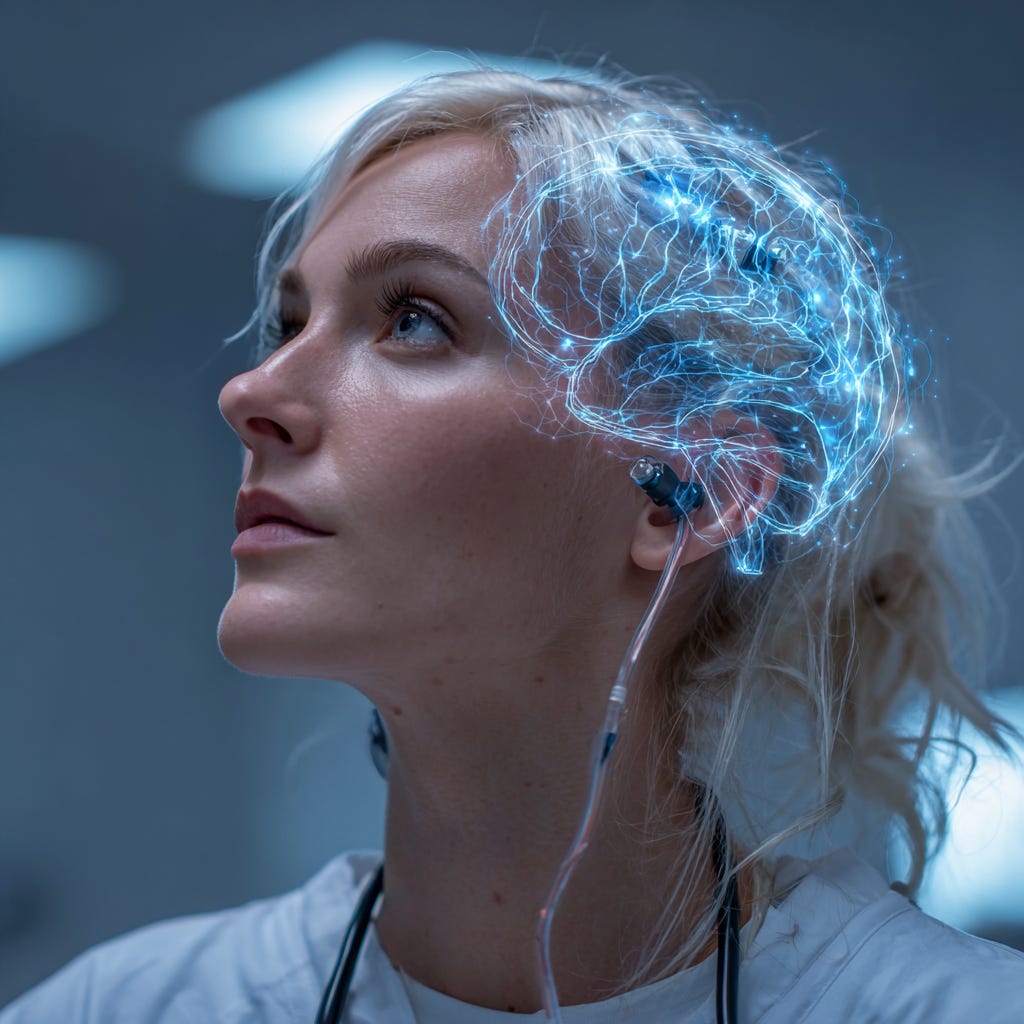
BCIs are still in early clinical trials, but progress has been rapid. For individuals with paralysis, advanced Parkinson’s, or severe speech and motor impairments, current systems already enable basic communication and computer control through neural signals. Once these devices become safe, reliable, and widely available, a secondary and very profitable market will likely emerge.
We’ve seen this pattern before. Ozempic was designed for Type 2 diabetes. When people realized it could shave off those stubborn ten or twenty pounds, demand exploded. It’s been completely normalized by celebrities and civilians alike.
The same logic applies to BCIs. If a device can restore lost function, someone will ask whether it can enhance healthy function too. And companies will inevitably capitalize on demand.
The World of AI BABY
In my novel, a powerful tech executive named Lannie Kingsley understands this better than anyone. Her company is launching a medical‑grade BCI to treat neurological conditions. But she knows the real market isn’t just patients. It’s the people willing to pay a fortune for genius‑level cognition.
I’m not the only one thinking BCIs will go mainstream. Forbes magazine said in October 2025:
“BCI is nearing an inflection point in terms of real-world functionality (…) Before long, these products will be ready for mainstream use and will begin to spread through society.”
Advancing this technology requires the convergence of neuroscience, biomedicine, hardware engineering, and AI. And for the people who rely on these tools to improve their daily lives, progress can’t come fast enough.
Brain–computer interfaces connect neural activity directly to digital systems. They generally fall into four categories:
1. Non‑invasive—These don’t require any medical procedure. Sensors sit outside the skull and detect electrical activity through the scalp. They’re safe and easy to use in the form of a cap, headband, or other wearables. But the skull filters and distorts signals, so the data is lower‑resolution.
2. Semi‑invasive—These systems are placed under the skull and sit on the brain’s surface. They require craniotomy surgery, but don’t penetrate the cortex.
3. Invasive—These implants require craniotomy and place electrodes directly into brain tissue. The procedure is riskier but delivers the highest‑quality signals because they record from neurons at the source. Elon Musk’s Neuralink is the most well‑known example of a company developing fully invasive BCIs.
4. Biohybrid—Science Corporation is pursuing one of the most sci-fi paths with great potential. Biological neurons from stem cells are grown in the lab, and the living cells are integrated with electronic components. The goal is to create a device that behaves more like the brain itself for more adaptive communication between biological and digital systems.
Current research focuses on restoring lost abilities:
Neuralink’s early human trials allowed Noland Arbaugh, a paralyzed participant, to control a computer cursor and perform digital tasks using only his thoughts.
Stanford researchers recently decoded imagined speech from brain activity, enabling people who can no longer speak a way to communicate.
These are extraordinary medical breakthroughs. But they also provide a Pandora’s box just waiting to be opened.
Will enhancement become the real business model? Once a device proves safe and effective, will healthy people elect to get BCIs and gain superhuman intelligence?
In AI BABY, the answer is yes. The same neural implant that treats disease can connect to cloud‑scale AI models, delivering knowledge, reasoning, and problem‑solving directly to the cortex. Want to solve unsolvable math? Just think. The answer is instantaneous and Seamless.
What begins as therapy becomes a profound brain upgrade — available only to those who can afford it. A new cognitive elite. Vulcans among us without the pointy ears.
And what about everyone else?
If intelligence becomes a product to be bought and sold, who gets access? Who gets left behind? What does it mean to be human when some people can think at superhuman capacity, and the rest of us… can’t? AI BABY raises these questions and provides a few unsettling answers.
A humorous take on the AI apocalypse— when a ‘perfect’ new girl arrives at an elite Seattle prep school & threatens Zoey’s dominance & Ivy League dreams, her mother Erica embarks on an unhinged search for truth that pulls her into the heart of an AI empire and a fight for her daughter’s soul.

Sources:
The Past, Present And Future Of Brain-Computer Interfaces
Invasive vs. Non-Invasive BCI: Understanding the Differences | RF Wireless World
Types of BCIs: invasive, semi-invasive, and non-invasive |... | Fiveable
Scientists develop interface that ‘reads’ thoughts from speech-impaired patients | Stanford Report
A Year of Telepathy | Updates | Neuralink
Neuralink’s First Human Patient Controls Cursor and Draws Using His Mind | WION Podcast
Congratulation, that would be a good read
When I started reading, my first question was "so that what"? Outside of a medical need, why do we want an implant for superhuman intelligence?
Too many high IQ humans without a balance of the more than 27 (and counting) lines of intelligences will get us what? Further destroying the planet for more money to buy more things? At a Dear cost to humanity and the planet.
I don't know of a case of altruistic invention.
If the LLM they are going to tap into is Musk's we are in faster trouble.
Governments are not known to be proactive, ever. When humans run government and lobbyists influence (I experienced this first hand when I was in the biodiesel industry), reaction and money wins the day (even when we don'tsee the truth of the shenanigans behind the scene.
What also comes to mind (not directly related, more to the tendency to intervention) is scheduled c-sections. When they are necessary they save lives. When they are for convenience or astrological reasons they rob the new life of a very human process and health benefit.
We have moved so far away from being humans sharing the planet with all life toward the increased power, destroy and win energy.
Looking guards to your book!