

In my novel AI BABY, I describe the harrowing experience of Erica teaching her daughter Zoey to drive. This scene might feel familiar to anyone who has taught a teen to drive…
Zoey got out of their neighborhood without incident, but Evergreen Point, the world’s longest floating bridge, which crossed Lake Washington, was ahead. The lineup of cars following them across the 520 was a mile long with a continuous stream passing her on the right.
“Honey, you’re in the fast lane. You need to move to the right.”
“I can’t! They’re moving too fast.”
Erica had forgotten to put the student driver magnet on the bumper, as if a sign could inoculate them against road ragers, so she frantically scribbled STUDENT DRIVER on a piece of paper from Zoey’s backpack and held it up in the passenger window as she mouthed, “Sorry.”
“That guy just flipped me off!” Erica rolled down the window. “Eff you too. My daughter’s learning to drive!”
For Zoey and her mother, autonomous vehicles (AVs) cannot come fast enough, and the transition is as inevitable as the adoption of cars over horse drawn carriages.
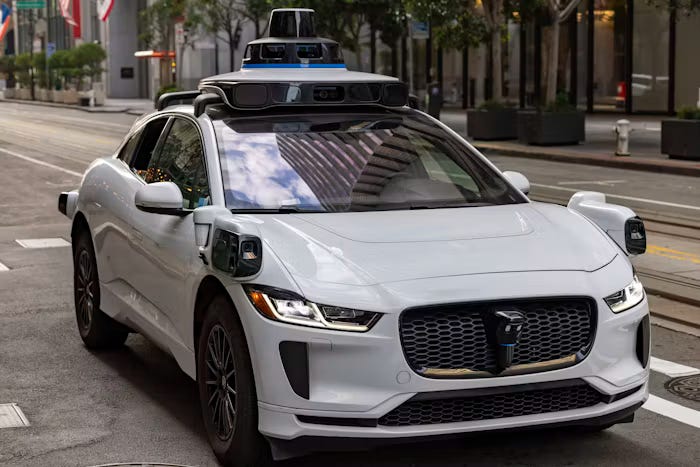
Waymo shared its latest safety data through the end of March 2026 and the results are impressive—autonomous vehicles were involved in 94% fewer crashes that caused serious or fatal injuries.
It’s impossible to argue against that kind of safety record when currently more than 100 people in the US die every day in traffic accidents, mostly due to impaired or distracted driving and speeding. All of which are eliminated in autonomous driving.
To clarify, today’s robotaxi fleets operate only within limited environments. Waymo vehicles use a combination of cameras, radar, and LiDAR, and require training and testing from detailed digital mapping, traffic patterns, road signs and signals. They currently stay within defined boundaries.
The goal of a truly autonomous vehicle would be to travel on virtually any road without requiring pre-mapping or specific training on every nuance of the rules and conditions. Tesla’s approach relies primarily on cameras and AI models that interpret the environment in real time, allowing the vehicle to make driving decisions on the fly rather than depending on detailed high-definition maps of a particular area.
As robotaxis become pervasive, inexpensive, and capable of operating almost anywhere, individual car ownership may not be necessary or even desirable. Robotaxi fleets are a far more efficient use of resources. While privately owned cars sit idle most of the time, robotaxis can remain in almost continuous use aside from maintenance and cleaning. In a recent Equity Mates podcast, Bryce Leske and Alec Renehan noted that Waymo’s parent company, Alphabet, has enormous leverage in digital advertising. They speculated that rides could eventually become free if passengers are willing to listen to ads.
But old habits die hard. For more than a century, cars have been symbols of status, individualism, and freedom. We’re already seeing increasingly sophisticated driver-assistance features from companies like Tesla and Mercedes. Despite Elon’s claims, Teslas are not yet fully autonomous, but that day will come. Will there still be the thrill of ownership once humans are no longer in command of accelerating, maneuvering and split-second decisions? The market for individually owned vehicles could shrink dramatically.
Like almost everything AI, battle lines are being drawn. According to the Bureau of Labor Statistics, about 500,000 people in the U.S. earn their living transporting passengers. Millions more around the world depend on driving for income. In cities like Boston, unions are lobbying city government to ban Waymo or other robotaxi services, while driverless car providers, safety experts and people with disabilities are advocating for autonomous vehicles. The development of AVs will have dramatic social and economic implications and there may be winners and losers in this fight. For the drivers, there is no way to tell if new opportunities will arise with advancing technologies as their current profession becomes obsolete. And despite the AI Maximalists predicting abundance everywhere there is no defined path for government or the private sector to address temporary or permanent displacement.
Driving is one of the most dangerous activities humans engage in on a regular basis. I don’t make a lot of predictions with AI but I have a strong hunch that eventually there will only be autonomous vehicles on roads and freeways, and human controlled driving will be banned. Safety and transportation are heavily regulated and public policies historically favor safety. Driving might become a hobby where people go to tracks or the outback and race around in old-fashioned human driven cars. I wouldn’t mind being chauffeured around in an autonomous vehicle, but I might lose my mind because AVs will always drive the speed limit and obey the rules of the road.
AI BABY, the novel by Celeste Garcia, is now available.

References:
The Equity Mates. Podcast, July 5, 2026.
Thoughts on the Market (Morgan Stanley). “Robotaxis’ Trillion Dollar Opportunity.” Podcast, August 13, 2026.
Freakonomics Radio. “Are Human Drivers Finally Obsolete?” Podcast, March 24, 2026.
Freakonomics Radio. “In a Driverless World, Who Wins and Who Loses?” Podcast, March 20, 2026.
Autonomous EVs Outperform Human Drivers According to Waymo Safety Data. ArenaEV.
So, reading this exposed a conflict within my thinking. Whereas I have no qualms being operated on by a robot surgeon, I feel uncomfortable being driven by fully autonomous cars! Hmmm. I’ve got to think more about why this is the case!
Waymo may be involved in less accidents, but they are in the news all the time for blocking traffic, including emergency vehicles, and acting really weird in parking lots. Not a good look. As for Tesla robotaxis, the prototype for this in Vegas is utterly stupid and getting more stupid by the day: https://www.youtube.com/watch?v=VPjODKUxV5g
Not to mention the deaths caused by reckless use of autopilot which is a live experiment that other drivers on the road never consented to. Self-driving still seems like a juvenile attempt to manifest something from science fiction that the founders of these tech companies have entirely misjudged and mishandled.